
XPG LANCER BLADE RGB DDR5 6000 MT/s Non-Binary Memory Unboxing

XPG, the gaming sub-brand of AVerMedia, introduces LANCER BLADE RGB DDR5 non-binary memory, which supports Intel XMP 3.0 and AMD EXPO one-click overclocking certification, allowing users of Intel 12/13/14th and AMD Ryzen 7000 platforms to enjoy overclocking up to 6,000 MT/s performance easily. The low profile heatsinks come with RGB light bars for excellent heatsink compatibility and the ability to customize lighting effects.
XPG LANCER BLADE RGB DDR5 6000 MT/s 24GBx2 memory specification:
Capacity: 48 GB (2x 24 GB)
Speed: DDR5 6000 MT/s
Sequence: CL30-40-40-76
Voltage: 1.35V
Specification: 288-Pin DDR5 UDIMM
Dimensions: 133.35 x 40 x 7.86 mm
Overclocking Support: Intel XMP 3.0 Certification (Extreme Memory Profile) & AMD EXPO Certification (EXtended Profiles for Overclocking)
Warranty: Lifetime Limited Warranty
XPG LANCER BLADE RGB DDR5 6000 MT/s 24GBx2 Memory Unboxing
XPG, the gaming sub-brand of ADATA AVerMedia, has added a new non-binary 24GB single-bar version to its existing LANCER BLADE RGB DDR5 memory series, and supports Intel XMP 3.0 (Extreme Memory Profile) and AMD EXPO (EXtended Profiles for Overclocking) one-click overclocking certifications. PROFILES FOR OVERCLOCKING) certifications.
The lighting control section supports ASUS/ASRock/Gigabyte/MSI motherboards' lighting control software. If you don't like the board's lighting control software, you can also customize your own lighting effects through XPG Prime, and if you have purchased other XPG hardware, you can also use Prime to synchronize your lighting effects.

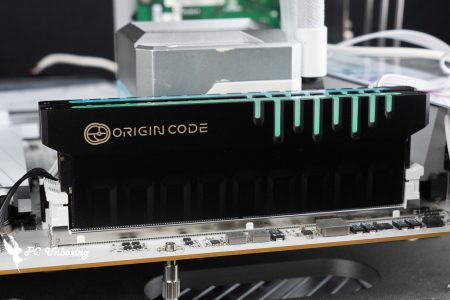
∆ XPG LANCER BLADE RGB DDR5 6000 MT/s 24GB x2 memory.

∆ 24 GB x2, 6000 MT/s, AMD EXPO, Intel XMP 3.0.

∆ Product No.: AX5U6000C3024G-DTLABRBK.
The XPG LANCER BLADE RGB DDR5 measures 133.35 x 40 x 7.86 mm in length, width, and height, and features a short version of the heatsink that will be more compatible with some air-cooled towers, but down-blown coolers should still be difficult to compatible.

∆ Length, width and height dimensions are 133.35 x 40 x 7.86 mm.

∆ The front and back sides are the same design and can only be recognized as the back side by the label sticker; the front side is the one without the label sticker.

∆ Laser engraved XPG DDR5.

∆ uses a single-sided cell (1R x8) layout, i.e. a single cell capacity of 3 GB x8.
XPG LANCER BLADE RGB DDR5 is equipped with an RGB light bar, which will automatically light up when the platform is powered on, and the lighting of the memory itself is considered to be flexible and saturated, and is of a less harsh type.

∆ Unpowered light bar.

∆ Lighting effect top view.

∆ The lighting effect is not harsh.

∆ belongs to a more flexible feeling.

∆ However, it is easier to create a phase bead feeling with some colors.
AMD Platform Memory Performance Test

Firstly, we will use AMD Ryzen 7000 platform which supports DDR5 memory to see how this set of memory performs on AMD platform. We will use AMD Ryzen 9 7900 processor and MSI MEG X670E ACE motherboard to test the XPG LANCER BLADE RGB DDR5 6000 MT/s 24GBx2 memory, and the motherboard BIOS will be updated to 7D69v1D5 (Beta version) to test it. The motherboard BIOS was updated to version 7D69v1D5 (Beta version) for testing.
Testing Platform
Processor: AMD Ryzen 9 7900 (PBO AUTO)
Cooler: AMD Wraith Prism
Motherboard: MSI MEG X670E ACE (BIOS version: 7D69v1D5 [Beta version])
Memory: XPG LANCER BLADE RGB DDR5 6000 MT/s 24GB x2
Display Card: MSI GeForce GTX 1070 Quick Silver 8G OC
Operating System: Windows 11 Professional 23H2
System Drive: Kingston A2000 NVMe PCIe SSD 500GB
Power Supply: FSP Hydro PTM PRO ATX3.0 (PCIe5.0) 1200W
Case: STREACOM BC1 Benchtable V2
Graphics driver: GeForce Game Ready 551.23
In the BIOS of the MSI MEG X670E ACE motherboard, you can see that this set of memory has a built-in XMP Profile file, DDR5 6000 CL 30-40-40-76 1.35 V for Intel XMP and EXPO, for the sake of compatibility with the AMD platform for stable use, so the frequency will be set at the conservative DDR5 6000, which is the strategy adopted by most of the current memory brands. This is also the strategy adopted by most memory brands.

There is only one Profile parameter in the ∆SPD HUB for XMP and EXPO.

∆ JEDEC frequency is DDR5-4800.

View of the Profile parameters shared by ∆.
Again. CPU-Z Looking at the AMD Ryzen 9 7900 and MSI MEG X670E ACE platforms, the SPD page shows that the XPG LANCER BLADE RGB DDR5 utilizes SK Hynix chips and supports EXPO and Intel XMP 3.0 one-click overclocking technology.

∆ AMD platform CPU-Z.
follow AIDA64 Cache & Memory Benchmark XPG LANCER BLADE RGB DDR5 6000 MT/s 24GB x2 read/write performance was tested at JEDEC frequencies of 73,299 MB/s and 61,949 MB/s with a latency of 85.3 ns.
With the EXPO Profile DDR5-6000 turned on, the read and write performance is 73,196 MB/s and 73,684 MB/s with 72.2 ns latency.
The author also manually overclocked to 8000 MT/s CL 42, and the read/write performance was 84975 MB/s and 87834 MB/s with 70.3 ns latency.

∆ EXPO Profile DDR5-6000 test results.

∆Test results of manual overclocking to DDR5-8000.

A screenshot of the ∆ part of the test result is provided for reference.

∆ AIDA 64 cache and memory test items, read speed, write speed test charts.

∆ AIDA 64 cache and memory test project latency performance.
And then through AIDA64 System Memory Tested for memory pressure stability with the memory EXPO Profile parameter DDR5-6000 CL 30-40-40-76 1.35V, and the SPD Hub temperature peaked at 62.3°C after 42 minutes of testing.
It is important to note that this X670E ACE was tested on the STREACOM BC1 Benchtable V2 barebones platform, and there is no additional fan in the memory to assist with cooling, but most users will have an exhaust fan installed above the chassis to dissipate the heat, so this is just a reference for temperature testing.

∆ AIDA64 system memory temperature test, SPD Hub up to 62.3 °C.
Intel Platform Memory Performance Test

Next, we tested the XPG LANCER BLADE RGB DDR5 6000 MT/s 24GB x2 memory using an Intel Core i9-13900K test platform that supports DDR5 memory and XMP 3.0, with an MSI MEG Z690I UNIFY on the motherboard and the BIOS updated to version 7D29v1G.
Testing Platform
Processor: Intel Core i9-13900K (QS)
Cooler: Valkyrie E360 (full speed)
Water-cooled fan: LIAN LI UNI FAN P28 (full speed)
Motherboard: MSI MEG Z690I UNIFY ( BIOS version: 7D29v1G )
Memory: XPG LANCER BLADE RGB DDR5 6000 MT/s 24GB x2
Graphics: MSI GeForce GTX 970 GAMING 4G Golden Edition
Operating System: Windows 11 Professional 22H2
System Drive: Plextor PCIe Gen3 x4 M.2 2280 SSD 512GB
Gaming Disk: Intel 670P 2TB M.2 2280 PCIe SSD (Solidigm)
Power Supply: MONTECH TITAN GOLD 1200W
Graphics driver: GeForce Game Ready 551.23
By the same token CPU-Z View Intel Core i9-13900K test platform.

∆ Intel platform CPU-Z.
Also use AIDA64 Cache & Memory Benchmark XPG LANCER BLADE RGB DDR5 6000 MT/s 24GBx2 was tested for read/write performance with the XMP Profile DDR5-6000 on and the test results were 92,129 MB/s read/write and 80,639 MB/s read/write with a latency of 77.3 ns.
The author also manually overclocked to a maximum of DDR5 8000 MT/s, but I don't know why the 8000+ frequency just can't pass the self-test of the motherboard, so I'll leave it to the gamers to figure out the higher frequency.

∆ XMP 6000 CL 30-40-40-76 Test performance.

∆The author manually overclocked up to 8000 MT/s.

A screenshot of the ∆ part of the test result is provided for reference.

∆ AIDA 64 cache and memory test items, read speed, write speed test charts.

∆ AIDA 64 cache and memory test project latency performance.
Conclusion

The XPG LANCER BLADE RGB DDR5 6000 MT/s 24GB x2 memory in this hands-on unboxing is compatible with the one-click overclocking features of both Intel and AMD DDR5 platforms, namely Intel XMP 3.0 (Extreme Memory Profile) and AMD EXPO (EXtended Profiles for Overclocking). EXtended Profiles for Overclocking).
Both platforms can use their own dedicated overclocking function to easily achieve one-click overclocking to DDR5 6000 MT/s. However, in order to provide better compatibility between the two platforms, it seems that XPG is only offering up to 6400 MT/s on this series, and most of the memory brands' models that are compatible with both XMP and EXPO will be locked below 6600 MT/s, which is the current mainstream operation in the market (for stable booting). This is also the mainstream operation in the current market (for stable booting).
This unboxing is only because LANCER BLADE RGB DDR5 has added a new non-binary capacity, that is to say, the series is currently available in 16 GB / 24 GB / 32 GB capacities, but will there be a 48 GB capacity added in the future so that consumers can use up to 192 GB on 4DIMM motherboards? That's where XPG comes in.
The latency of this set of memory is 77.3 ns and 72.2 ns after turning on the DDR5 Profile parameter on both Intel and AMD platforms, which may not be a big difference for most users, but a small group of overclockers may think the latency is too high, but the latency can be lowered by manually overclocking to a higher frequency, so you can manually overclock the memory to get better latency performance. Therefore, if you want to get better delay performance, you may want to overclock manually.

Yun
Drinks with less than full sugar are colored water. Crossing Turbid Creek, full sugar is not a crime!


 繁體中文
繁體中文  English