
G.SKILL Trident Z5 RGB DDR5-7200 Non-Binary White Memory Unboxing Review

G.SKILL's flagship series of DDR5 memory products: Trident Z5 RGB, with a maximum frequency of up to DDR5 8400 MT/s, support for Intel XMP 3.0 Profile, and a wide range of memory capacity specifications such as 64 GB and 96 GB, and the one that I've got in my hands to open the box is the DDR5-7200 in Snow White. CL36 non-binary 48GB (2x24GB) memory, the author in the 13900K and MSI MEG Z690I UNIFY platform can be a small override to DDR5 8266 MT/s, to further squeeze the Trident Z5 RGB Phantom Halberd more performance at the same time to break the rumors that the G.SKILL can not be override!
G.SKILL Trident Z5 RGB DDR5-7200 48GB (2x24GB) Memory Specifications:
Serial No.: F5-7200J3646F24GX2-TZ5RW
Capacity: 48 GB (2x 24 GB)
Speed: DDR5 7200 MT/s
Chronology: CL36-46-46-115
Voltage: 1.35V
Specification: 288-Pin DDR5 UDIMM
Warranty: Lifetime Warranty
Length, width and height dimensions: ? x ? x 44 mm
Profile Certification: Intel XMP 3.0 Certified (Extreme Memory Profile)
G.SKILL Trident Z5 RGB DDR5-7200 48GB (2x24GB) Memory Unboxing
G.SKILL's flagship DDR5 memory series, the Trident Z5 RGB, was actually launched in October 2021, and was one of the first wave of memory models that could be used with Intel's 12th (Alder Lake) DDR5 platform, so subsequent updates were basically frequency and memory capacity changes.
The unboxing of the Trident Z5 RGB DDR5-7200 is a non-binary 48 GB (2x 24 GB) version, which is 8 GB more memory capacity than the common 32 GB (2x 16 GB) single bar, and with the common 4 DIMM motherboard expansion installation can reach 96 GB memory capacity.
The Trident Z5 RGB is available in Tech Silver, Dull Mist Black, and today's unboxing Snow White, but Tech Silver seems to have an extra slash design on the heatsink, so it's up to each consumer's preference.

∆ G.SKILL Phantom Halberd Trident Z5 RGB.

∆ Support Intel XMP 3.0.

∆ Remember to check the specification sticker on the memory unit after purchase to see if it is the same specification as the model you want to purchase.

∆ Support ASUS Aura Sync, GIGABYTE RGB Fusion, MSI Mystic Light Sync, ASRock Polychrome Sync lighting control software.
The Trident Z5 RGB is only labeled as 44 mm in height on the official website, the length and thickness are not even labeled, in fact, even the height is separately placed in the FAQ to specifically check.
The Snow White color itself is a combination of a plain heatsink with black brushed horizontal stripes, and the Trident Z5 RGB series logo is printed on the right half.

∆ G.SKILL Phantom Halberd Trident Z5 RGB White.

∆ Trident Z5 RGB series logo.

∆ Streamlined design.

The back of the ∆ is of the same design, with the date of manufacture and the relevant specifications printed on the specification sticker.
The Trident Z5 RGB continues the unique aluminum cooling fins of the Trident series, but unlike the DDR4 version of the Trident, the Trident Z5 RGB uses a sleeker streamlined design, with S-shaped lines that are quite different from the previous presentation.

The ∆ S-shaped flow design with aluminum alloy heat sink provides different aesthetics.

∆ G.SKILL light bar display.
The Trident Z5 RGB DDR5-7200 48 GB (2x 24 GB) memory I have in my hands is laid out in a single-sided cell (1Rx8) layout, with 3 GB of capacity per cell for a total of 24 GB.
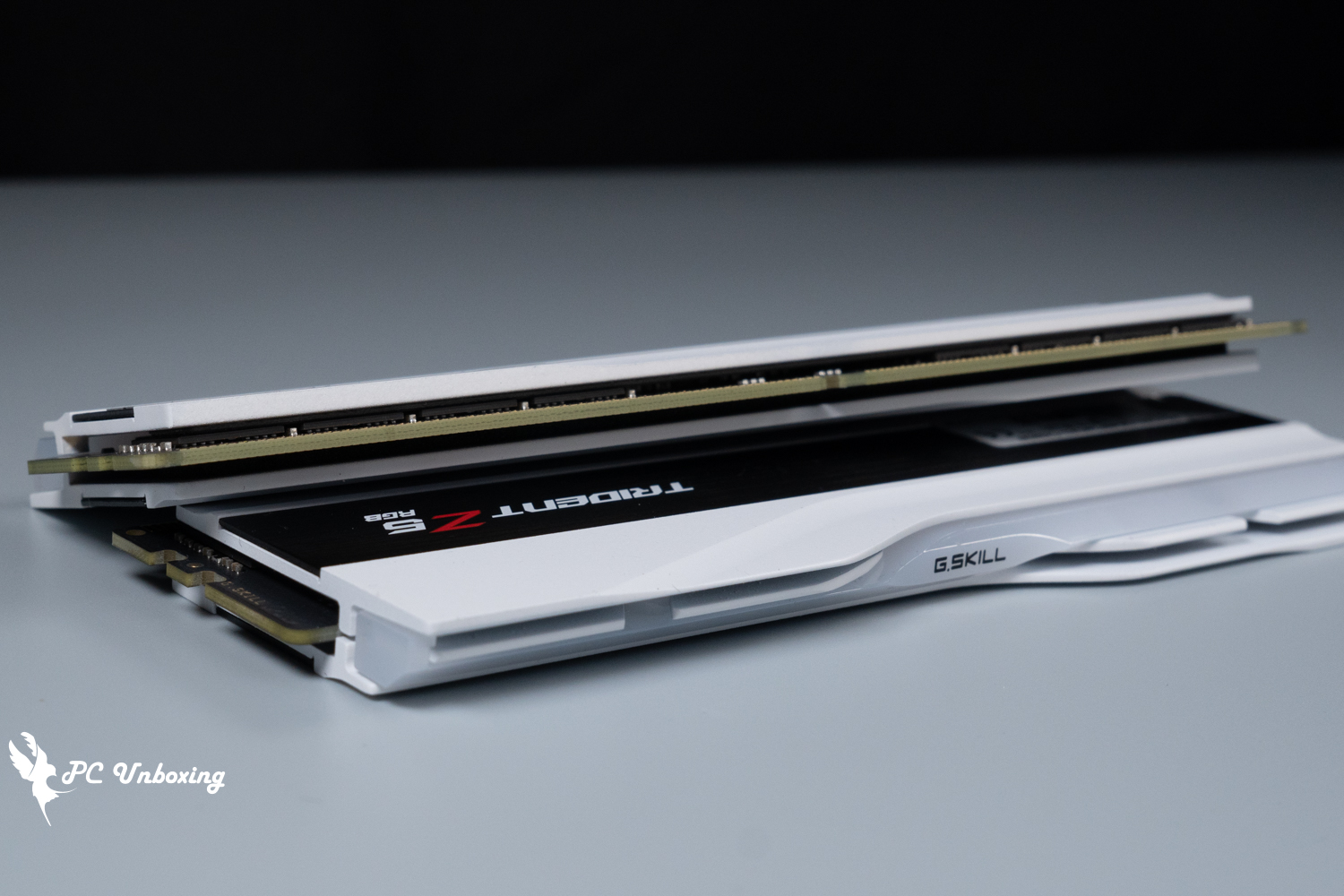
∆ 1Rx8 layout, which is also the more common way to type parts for high frequency DDR5 memory today, as it is easier to stabilize (i.e., it is easier to get on high frequencies) at high frequencies.
Trident Z5 RGB Memory Lighting Effect Showcase
G.SKILL Trident Z5 RGB memory is installed on both 2DIMM and 4DIMM motherboards to demonstrate its auto-lighting effect for your viewing pleasure.


AMD Ryzen 9 7900 and MSI MEG X670E ACE platform memory overclocking test.

First of all, we will use AMD Ryzen 7000 platform which supports DDR5 memory to see how this set of memory performs on AMD platform, using AMD Ryzen 9 7900 processor and MSI MEG X670E ACE motherboard to test G.SKILL Phantom Halberd Trident Z5 RGB DDR5-7200 48GB ( 2x24GB) memory, motherboard BIOS updated to version 7D69v1D for testing.
Testing Platform
Processor: AMD Ryzen 9 7900 (PBO AUTO)
Cooler: AMD Wraith Prism
Motherboard: MSI MEG X670E ACE (BIOS version: 7D69v1D)
Memory: G.SKILL Phantom Halberd Trident Z5 RGB DDR5-7200 48GB (2x24GB)
Graphics: MSI GeForce GTX 970 GAMING 4G Golden Edition
Operating System: Windows 11 Professional 23H2
System Drive: Kingston A2000 NVMe PCIe SSD 500GB
Power Supply: FSP Hydro PTM PRO ATX3.0 (PCIe5.0) 1200W
Case: STREACOM BC1 Benchtable V2
Graphics driver: GeForce Game Ready 551.23
由 CPU-Z Looking at the AMD Ryzen 9 7900 and MSI MEG X670E ACE platforms, the SPD page shows that the Trident Z5 RGB utilizes SK Hynix chipsets, which support the latest Intel XMP 3.0 one-click overclocking technology.
However, the SPD HUB only programs one set of XMP Profile parameters, and the rest are JEDEC timing parameters, which means that if the motherboard BIOS is using an earlier version or if your platform is in poor condition, and you can't start the XMP 7200 Profile smoothly, you can only use the JEDEC frequency.

∆ AMD platform CPU-Z.
follow AIDA64 Cache & Memory Benchmark Testing the read/write performance of the Trident Z5 RGB DDR5-7200 48GB (2x24GB).
The author's AMD Ryzen 9 7900 and MSI MEG X670E ACE platforms are running on DDR5 5200 CL42 when entering the system without opening the default state of A-XMP Profile, and the read/write performance is 64181 MB/s and 65659 MB/s, with 83.8 ns latency after the test.
After turning on the A-XMP Profile's DDR5-7200 MT/s CL36-46-46-115 1.35V, the read/write performance increases to 77,915 MB/s and 81,455 MB/s with 81.2 ns latency.

∆ The author's AMD platform is running on DDR5-5200.

∆The DDR5-7200 MT/s with A-XMP Profile on shows a significant increase in both read and write performance and further reduces latency.
Then I continue to manually overclock this G.SKILL Trident Z5 RGB DDR5-7200 48GB (2x24GB) memory, and finally overclocked to DDR5 8000 MT/s.
Read and write performance is further improved to 84973 MB/s and 88801 MB/s, while latency is reduced to 67.5 ns.
In addition, the author also provides read/write performance charts of overclocking to DDR5 7400/7600/7800 for your reference.

∆ Manual overclocking to DDR5 8000 MT/s.

∆ AIDA 64 cache and memory test items, read speed, write speed test charts.

∆ AIDA 64 cache and memory test project latency performance.
And then through AIDA64 System Memory The pressure stability of the memory was tested with the memory's built-in A-XMP Profile parameter DDR5-7200 MT/s CL36-46-46-115 1.35V, and the temperature of the SPD Hub peaked at 58.3 °C after 15 minutes of testing.
It is important to note that this X670E ACE was tested on the STREACOM BC1 Benchtable V2 barebones platform, and there is no additional fan in the memory to assist with cooling, but most users will have an exhaust fan installed above the chassis to dissipate the heat, so this is just a reference for temperature testing.
The other memory stick is cooler because it's closer to the AMD Wraith Prism downdraft cooler, so it's a little cooler than the other stick.

∆ AIDA64 system memory temperature test, SPD Hub up to 58.3 °C.

∆ The memory on the left is closer to the AMD Wraith Prism downdraft cooler, so the maximum temperature is only 55.5 °C; the one on the right, farther away, has a maximum temperature of 58.3 °C. The temperature of the memory on the left is only 55.5 °C.
Memory overclocking test for Intel Core i9-13900K and MSI MEG Z690I UNIFY platform.

Next, we used an Intel Core i9-13900K test platform with DDR5 memory and XMP 3.0 support, MSI MEG Z690I UNIFY on the motherboard, and updated the BIOS to version 7D29v1G to test the G.SKILL Phantom Halberd Trident Z5 RGB DDR5-7200 48GB (2x24GB). memory overclocking and read/write performance.
Testing Platform
Processor: Intel Core i9-13900K (QS)
Cooler: Valkyrie E360 (full speed)
Water-cooled fan: LIAN LI UNI FAN P28 (full speed)
Motherboard: MSI MEG Z690I UNIFY ( BIOS version: 7D29v1G )
Memory: G.SKILL Trident Z5 RGB DDR5-7200 48GB (2x24GB)
Display Card: MSI GeForce GTX 1070 Quick Silver 8G OC
Operating System: Windows 11 Professional 22H2
System Drive: Plextor PCIe Gen3 x4 M.2 2280 SSD 512GB
Gaming Disk: Intel 670P 2TB M.2 2280 PCIe SSD (Solidigm)
Power Supply: MONTECH TITAN GOLD 1200W
Graphics driver: GeForce Game Ready 551.23
By the same token CPU-Z View Intel Core i9 13900K test platform.

∆ Intel platform CPU-Z.
Also use AIDA64 Cache & Memory Benchmark To test the read/write performance of the Trident Z5 RGB, I had an Intel platform that was able to access the system at the default DDR5 5600 MT/s JEDEC frequency, and the test scores were 85163 MB/s read/write and 74832 MB/s write/read, with a latency of 89 ns.
With XMP Profile DDR5-7200 MT/s CL36-46-46-115 1.35V turned on, the test results were 112810 MB/s read/write and 97824 MB/s with 61 ns latency.

The ∆ 1DPC (1 Dimm Per Channel) i9-13900K and MSI MEG Z690I UNIFY platforms can run the system at the default DDR5 5600 MT/s frequency.

∆ Turning on the XMP Profile DDR5-7200 MT/s CL36-46-46-115 1.35V results in a significant improvement in read/write performance and a reduction in latency to 61 ns.
The author also manually overclocked to the maximum 8266 MT/s and tested it, the test results were 125960 MB/s and 103470 MB/s, with a latency of 60.7 ns. However, the higher 8400 MT/s could not pass the self-test of the motherboard.
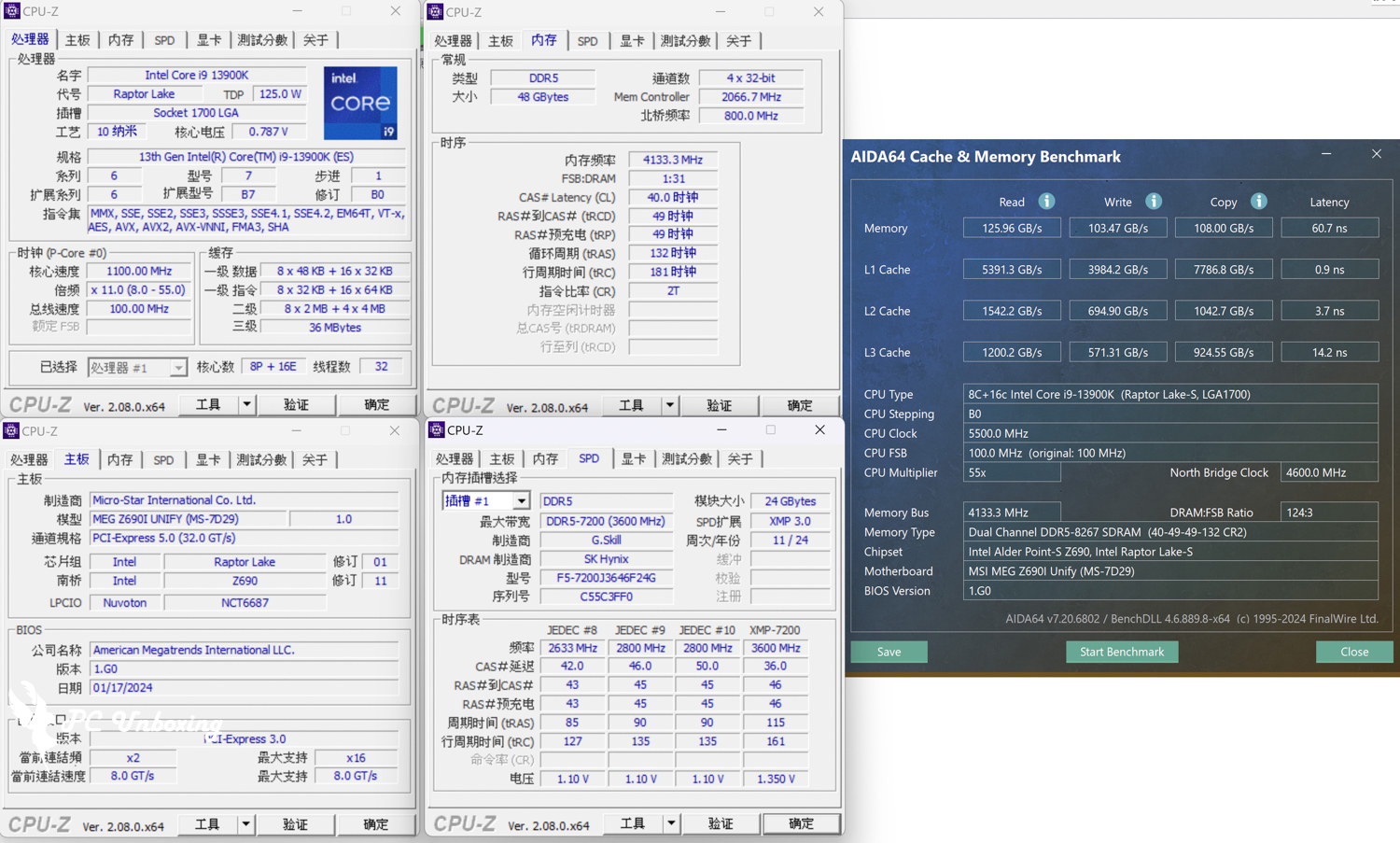
∆The author's platform can be overclocked to DDR5-8266 MT/s at the maximum.

∆ AIDA 64 cache and memory test items, read speed, write speed test charts.

∆ AIDA 64 cache and memory test project latency performance.
Conclusion
G.SKILL Trident Z5 RGB DDR5-7200 48GB (2x24GB) memory with DDR5-7200 MT/s CL36-46-46-115 1.35V XMP Profile parameter built-in SPD HUB allows consumers to easily enable memory overclocking via XMP / A-XMP with one click. The XMP Profile parameter allows consumers to easily overclock from the default JEDEC frequency to DDR5 7200 MT/s with a single click of the XMP / A-XMP function.
However, there is still room for improvement with only one XMP Profile parameter. Assuming that the user's platform is not able to use DDR5 7200 MT/s stably, there is no closer spare frequency that can be used (e.g., 6800 or 6600 MT/s, etc.), the author would recommend that in the future, G.SKILL can burn one or two additional lower profiles to be used for various situations.

This unboxing is a non-binary 48GB (2x24GB) capacity, which has the advantage of getting more memory space than the mainstream 32GB (2x16GB) in the same amount (two or four installations), especially for 2DIMM slot setups like ITX motherboards, where the larger the capacity of a single stick of memory is of course the better, but the price is also very high in relation to that.
In addition, G.SKILL Trident Z5's S-shaped aluminum heatsink design not only presents a unique aesthetic style out of the past, but also suppresses the maximum temperature of the SPD HUB at 58.3°C in a 15-minute stress test, proving that this memory heatsink has a good performance in terms of appearance and heat dissipation.

In terms of overclocking performance, the AMD Ryzen 9 7900 and MSI MEG X670E ACE platforms that the author has in hand can directly apply the DDR5-7200 MT/s CL36-46-46-115 A-XMP Profile to run the score test, and obtain 21.3% and 24% one-click overclocking read/write performance improvement.
The author also manually overclocked to DDR5 8000 MT/s, and further squeezed out 32.3% and 35.2% of read/write performance over the JEDEC frequency, and the latency was finally reduced from 83.8 ns (JEDEC frequency) to 67.5 ns.

In the Intel Core i9-13900K and MSI MEG Z690I UNIFY platforms, which have better memory overclocking performance, after turning on the XMP Profile DDR5-7200 MT/s CL36-46-46-115 1.35V, the read/write performance of 32.4 % and 30.7 % is easily improved, and the latency is also greatly reduced from 89 ns to 61 ns. The latency is also significantly reduced from 89 ns to 61 ns.
After manually overclocking to DDR5 8266 MT/s, the read performance gained 47.9 % over the default frequency, and the latency performance can be slightly tightened to 60.7 ns.

Before personally overclocking G.SKILL Trident Z5 RGB, the author has always heard gamers' comments about G.SKILL: just use XMP, can't overclock at all, but the author actually overclocked it a little bit and it is indeed able to overclock from DDR5 7200 to 8266 MT/s, the author breaks down this kind of message for everyone's reference.
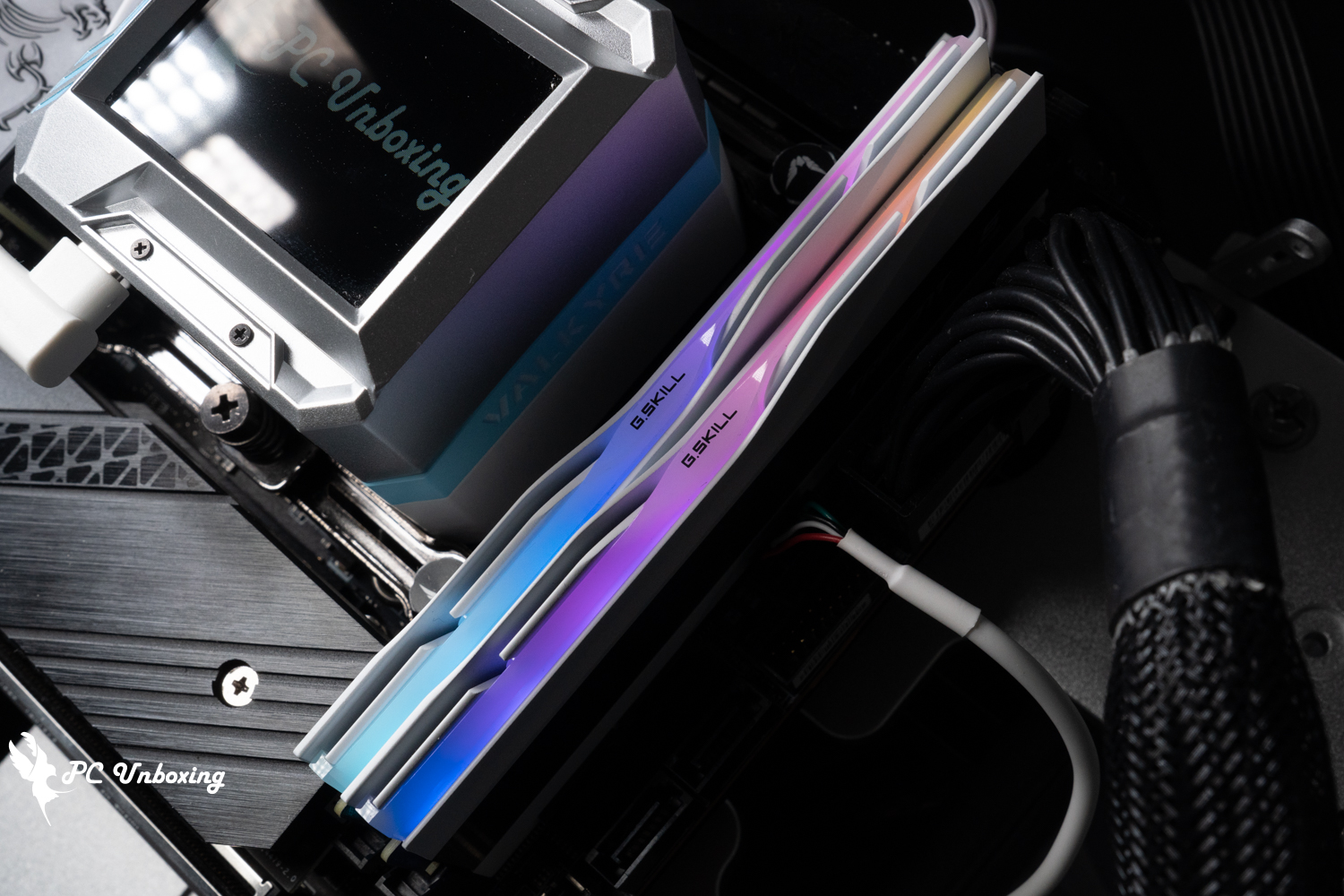
Of course, the overclocking ability and stability of memory depends on the quality of the CPU memory controller (IMC [Integrated Memory Controller]), BIOS version, motherboard design, memory particles and control, etc. Therefore, just because the author's platform can overclock up to 8266 MT/s doesn't mean that other people's platforms can directly copy it and overclock up to this frequency or can be used stably; just because other people can overclock to a higher frequency doesn't mean that I can overclock up to this frequency. Therefore, the fact that the author's platform can overclock to 8266 MT/s does not mean that other people's platforms can also copy it directly and overclock to this frequency or be able to use it stably.
Just like the small card attached by G.SKILL, these physical factors mentioned above will affect the stability of memory usage, therefore, as long as "different parts are individual", they will have their own overclocking limit and stable usage space, so most of the time, unstable memory usage can only be investigated by slowly selecting the conditions, and the only thing that consumers can do is to buy a 2DIMM motherboard (also known as a 1DPC motherboard) and update the BIOS version to get a better compatibility or overclocking space, while the rest is really up to fate. The only thing consumers can do is to purchase a 2DIMM motherboard (also known as a 1DPC motherboard) and update the BIOS version to get better memory compatibility or overclocking space, while the rest of the process really depends on the quality of the hardware components.


Yun
Drinks with less than full sugar are colored water. Crossing Turbid Creek, full sugar is not a crime!


 繁體中文
繁體中文  English